
When Success Never Feels Like Enough - The Hidden Cost of Imposter Syndrome
Oct 21, 2026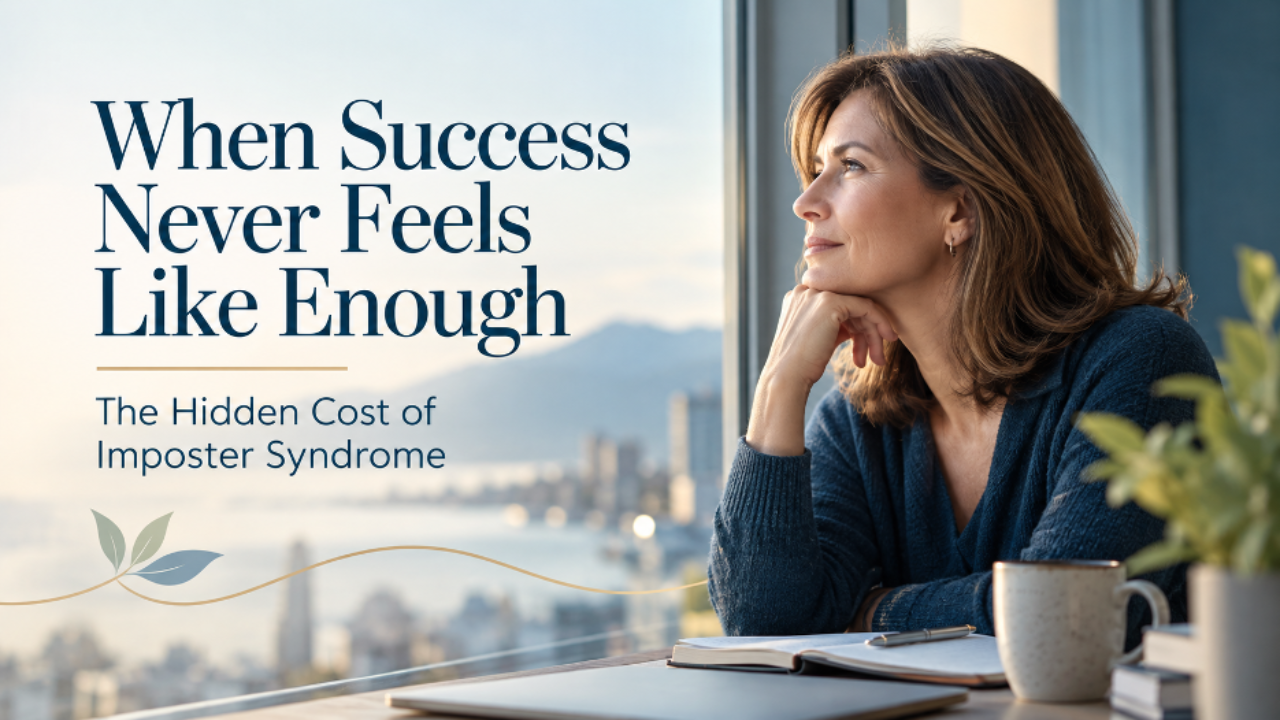
Discover why so many accomplished people feel they must constantly prove themselves - and how to begin breaking the cycle.
Have you ever achieved something you worked really hard for, only to find that the satisfaction was surprisingly short-lived?
Perhaps you received a promotion, completed a challenging project, earned a qualification or received recognition for something you'd accomplished.
For a moment, you felt proud. But before long, your inner voice started questioning whether you really deserved that success.
Maybe I just got lucky.
Perhaps the expectations weren't that high.
Next time, I might not be able to pull it off.
And instead of celebrating what you'd achieved, you started focusing on the next challenge, the next goal or the next opportunity to prove yourself.
Sound familiar?
The exhausting cycle of constantly proving yourself
One of the characteristics commonly associated with imposter syndrome is the inability to fully internalize our achievements.
Even when there's plenty of evidence that we're capable and competent, we may struggle to believe it.
Instead, we attribute our success to luck, timing, hard work or other people's generosity rather than acknowledging our own abilities.
And because we don't fully accept our successes, we feel compelled to keep proving ourselves.
We work harder. Prepare more thoroughly. Say yes when we'd rather say no. Set increasingly demanding standards for ourselves.
Sometimes we even avoid opportunities because we're afraid that this time we won't measure up.
From the outside, we may appear confident, capable and highly successful.
But on the inside, we're exhausted.
I know this experience personally
I spent more than 20 years working in the technology industry. I had a successful career, held positions of responsibility and received recognition for my contributions.
Yet throughout those years, I carried a persistent feeling that I was somehow a fraud.
I didn't have a computer science degree, and despite all the evidence of my competence, part of me worried that one day someone would discover I wasn't as capable as they believed.
Looking back, I realize how much energy I spent trying to prove myself and maintain the appearance of someone who had everything under control.
I was successful by many conventional measures, but I wasn't always being true to myself.
It wasn't until I left the industry and became a professional coach that I began to understand how deeply those feelings had influenced me.
And I've since discovered that I'm far from alone.
When achievement becomes a measure of our worth
There's nothing wrong with being ambitious, setting high standards or wanting to do excellent work.
The problem arises when our sense of self-worth becomes dependent on what we achieve or how others perceive us.
We begin to believe that we're only as good as our latest accomplishment.
And when success becomes something we must continually earn, rather than something we can acknowledge and appreciate, it can become an exhausting pursuit.
There's another consequence that I think deserves more attention.
When we're constantly trying to prove ourselves, we may stop asking whether what we're striving for is what we really want.
We pursue promotions because that's what successful people are supposed to do.
We accept responsibilities because we don't want to disappoint others.
We stay on paths that no longer inspire us because changing direction might look like failure.
Gradually, our decisions become shaped more by other people's expectations and the demands of our inner critic than by our own values and aspirations.
We can become very successful at building a life that doesn't feel entirely our own.
What if you didn't have to keep proving yourself?
Imagine what might change if you no longer felt compelled to demonstrate your worth through constant achievement.
What opportunities might you explore?
What responsibilities might you choose to release?
What might you give yourself permission to do differently?
Breaking free from imposter feelings isn't about abandoning ambition or lowering your standards.
It's about developing a healthier relationship with achievement and recognizing that your worth isn't something you have to continually prove.
It's about learning to acknowledge your successes, trust your abilities and make choices based on what matters most to you.
And it begins with awareness.
Three questions worth reflecting on
If any of this resonates with you, I invite you to pause and consider:
- When was the last time I genuinely acknowledged an accomplishment without immediately minimizing it or moving on to the next challenge?
Notice whether you allow yourself to feel proud of what you've achieved.
- Where in my life am I working harder than necessary because I feel I have something to prove?
Consider whether your effort is being driven by genuine enthusiasm and commitment, or by fear of not being good enough.
- If I no longer needed to prove my worth to anyone, what might I choose to do differently?
This may be the most powerful question of all.
You don't need to have immediate answers. Simply becoming curious about these patterns can be the beginning of meaningful change.
Success on your own terms
After more than 13 years of coaching, one thing I've come to believe deeply is that we all have unique gifts to offer the world.
But when our inner critic is constantly questioning our abilities, we can spend so much energy trying to prove ourselves that we lose sight of what truly matters.
My hope is that more people will recognize that they don't have to keep earning the right to feel good enough.
They can begin to trust themselves, acknowledge their achievements and make choices aligned with their own values rather than other people's expectations.
Because perhaps the most meaningful measure of success isn't how much you've accomplished.
It's whether the life you're creating is one that truly feels like your own.
I'm Sue Maitland, an ICF Professional Certified Coach (PCC), speaker and founder of Connect & Thrive Coaching. Through speaking engagements, workshops, individual coaching and the Connect & Thrive Community, I help people understand and move beyond imposter syndrome, quiet their inner critic and create lives aligned with what matters most to them.
Stay connected with news and updates!
Join our mailing list to receive the latest news and updates from our team.
Don't worry, your information will not be shared.
We hate SPAM. We will never sell your information, for any reason.
